Those of you old enough to remember the band Bananarama might recall their song that said:
“It’s not what you do, it’s the way that you do it.”
That line could just as easily be about learning a foreign language.
Because here’s the truth:
Most people don’t fail at learning a language — they just don’t understand how they learn.
Feeling stuck is incredibly common.
You might have studied for years, taken classes, watched films, downloaded apps… yet somehow, your progress seems to have stalled. You know some of the language, but you can’t seem to move beyond your current level.
➡️ It’s not about talent or motivation.
➡️ It’s about understanding yourself.
Because language learning isn’t one-size-fits-all — it’s deeply personal.
And that’s exactly why I wanted to spend some time writing about it.
Why I’m Writing This
Over the past few weeks, I’ve had a wave of people reach out to me following the masterclass I ran on language immersion.
Their situations varied, but their frustrations sounded remarkably similar.
Some had just started learning and said:
“Nothing’s sticking. I can’t build a routine, I don’t know what to do next.”
Others had been studying for a while and said:
“I’ve done everything my school told me to do, but it doesn’t feel right anymore.”
And many told me:
“I’ve reached a plateau. I don’t want to quit, but I’m stuck.”
It’s all incredibly humbling — and fascinating — to listen to.
But it also reminded me of something fundamental:
👉 No single methodology can work for everyone.
Anyone who tells you “we have the perfect method” is, frankly, not being honest.
There are many methods that work for many people — but language learning is personal. Deeply personal.
And that’s why, at VICI, we focus on language coaching, not language tutoring.
- Tutoring is about passing on what you know.
- Coaching is about discovering how the student learns.
- A tutor leaves the room — and their knowledge leaves with them.
- A coach leaves the room — and the learner carries that knowledge forward independently.
As I often remind my team:
“Be the guide on the side, not the sage on the stage.”
Our goal is to empower you to the point that, one day, as bittersweet as it is, we can say goodbye — because you no longer need us.
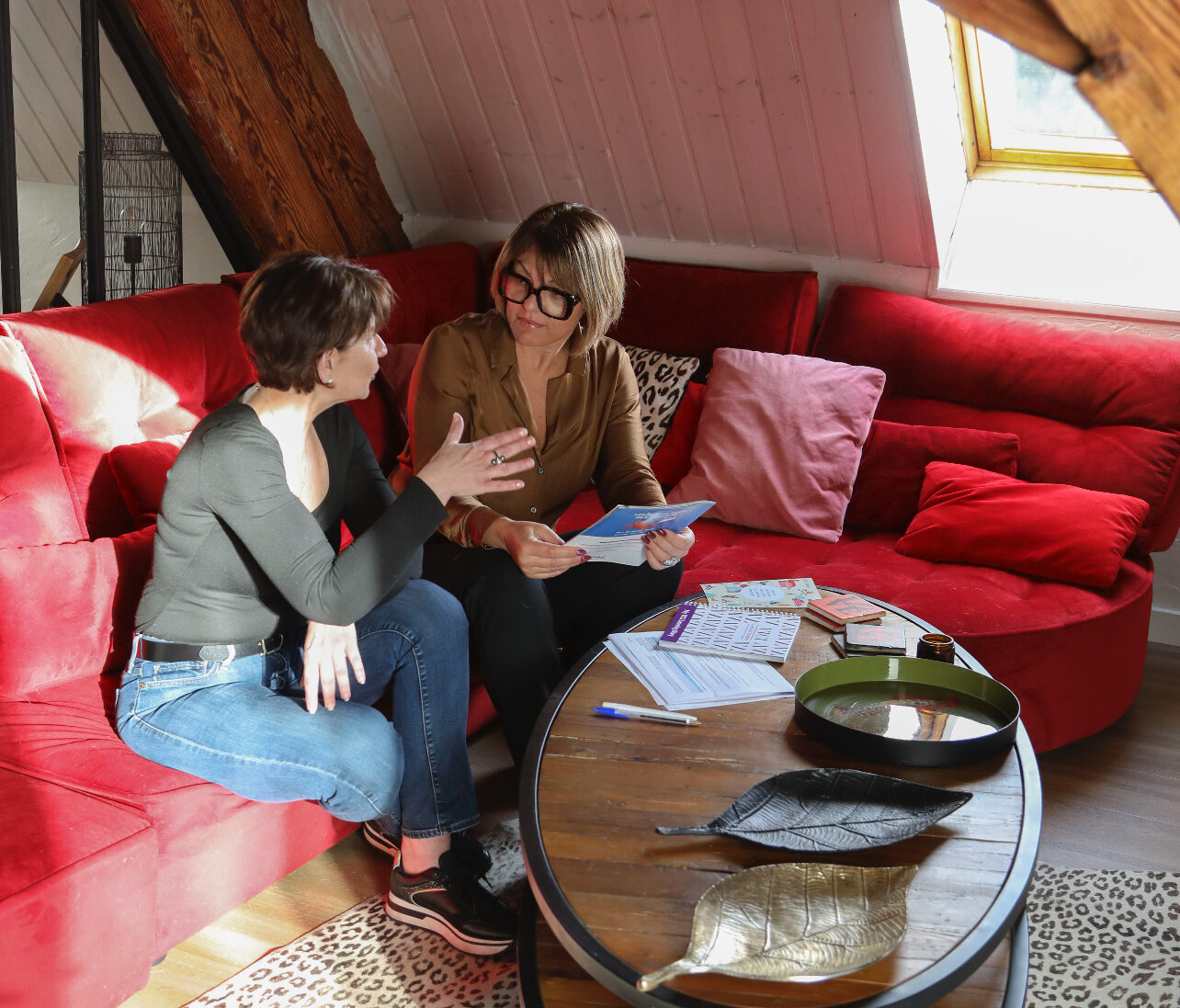
Behind the scenes at our French office — preparing the upcoming Jura immersion programme.
So, let’s look at how to get you unstuck and moving forward again:
Where Are You Now?
Before you can move forward, you have to know where you are.
This is where the Common European Framework of Reference for Languages (CEFR) comes in — a universal scale that defines language ability from A1 (beginner) to C2 (mastery).
But here’s what most people don’t realise: your level isn’t one neat label. It’s made up of five communicative skills:
-
Listening
-
Reading
-
Spoken interaction
-
Spoken production
-
Writing
Progress doesn’t happen “overall” — it happens within each skill. You might be a B2 speaker but an A2 writer. That’s perfectly normal.
Once you know this, you can measure your progress accurately — not emotionally.
👉 If you’d like to analyse where you currently are, I’ve developed a self-assessment tool based on the CEFR that you can use to identify your strengths and gaps.
Just email me at ndanon@thevici.com and I’ll be happy to share it with you.

Anthony joined us in Windsor for a full week of language and cultural immersion — an inspiring journey of English in action!
Where Do You Want to Go?
Once you know where you are, the next step is to ask: where do you want to go — and what does that actually mean?
Most learners say, “I want to get to the next level.” But do you understand how that happens?
If you dissect the CEFR scale, you’ll see that progress is not about jumping from A1 to A2 overnight — it’s about gradual mastery within each communicative skill.
-
In listening, maybe you move from needing full repetition to catching the gist of a short dialogue.
-
In speaking, you might go from giving single-word answers to describing a situation in simple terms.
-
In writing, progress might mean crafting a short, coherent paragraph instead of disconnected sentences.
When you divide your learning into clear, manageable steps (instead of seeing it as one big goal), you stop feeling overwhelmed and start noticing real, practical ways to improve.
You shift from “I want to get better at this” to “I can see exactly what to do next — and I know how to make progress.”
In other words, breaking things down turns your motivation into action.
That’s how you move forward deliberately, not by chance.
What’s the Context?
Context is the hidden engine of language acquisition.
We call it contextual learning — the process of acquiring language in a way that’s meaningful to your real life.
Think of it this way: your brain doesn’t store vocabulary in tidy lists.
It builds connections.
When you learn “coffee” in a café, with the smell of beans and the sound of the barista, that memory sticks because it’s contextualised.
This is why pure memorisation and grammar drills don’t last: they’re disconnected from reality.
Context creates emotional memory — and emotional memory drives retention.
So, whether you’re living abroad or at home, surround yourself with the real version of the language you want to learn.
- Read, listen, and think in that language every day.
- Build micro-immersion moments.
- Watch a series without subtitles, order your coffee in your target language, journal in short sentences — even if imperfectly.
That’s how language becomes part of your world, not just your study routine.
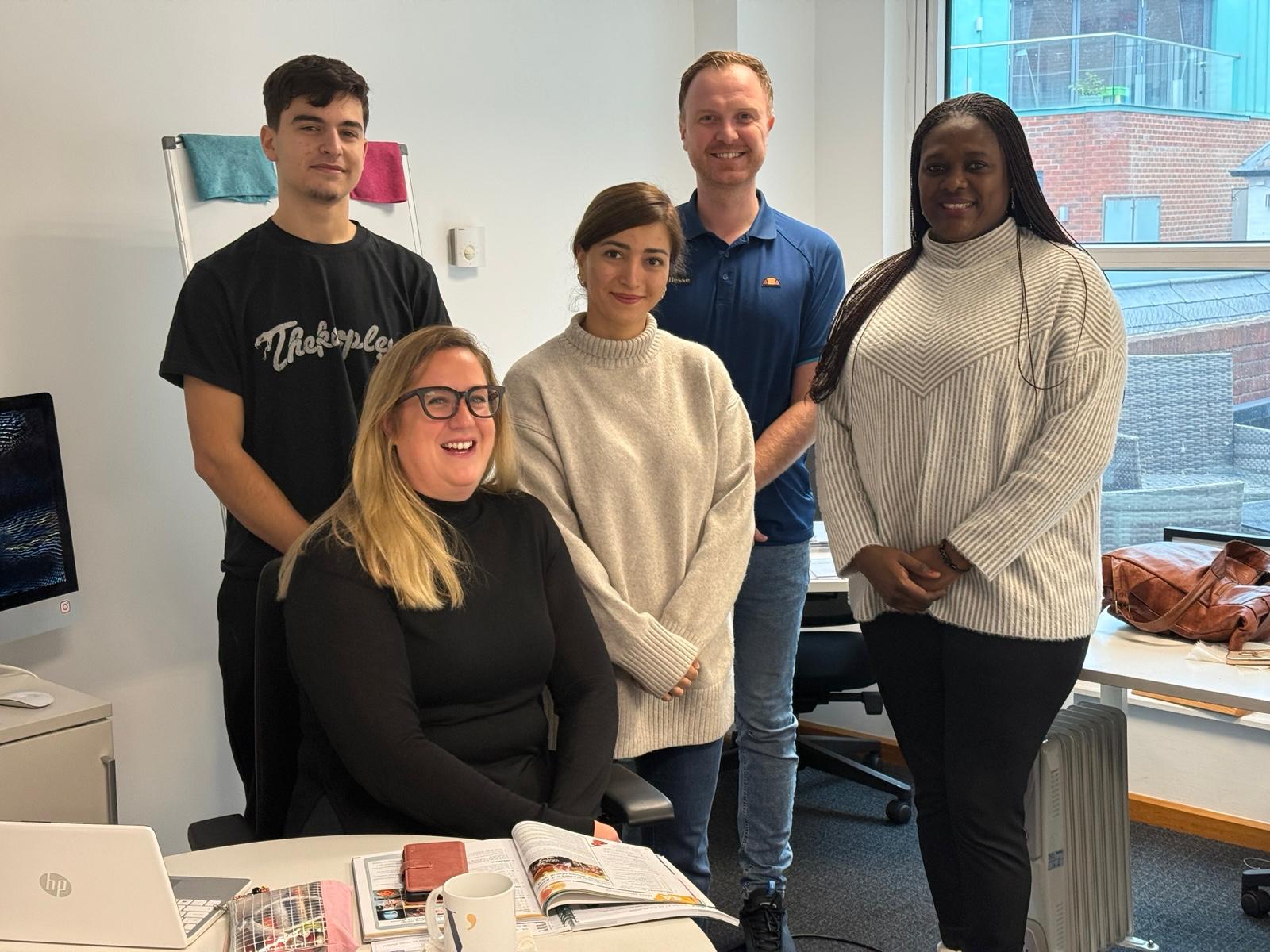
Katy and her wonderful group at our Windsor academy — learners from Iran, the Czech Republic, Congo and France, all sharing one goal: learning English together.
The Role of Personality in Colours
Have you ever wondered why some lessons energise you and others drain you?
It might have less to do with the subject — and more to do with your personality colour.
Here’s a quick guide:
🟡 Yellow: You’re lively and spontaneous. You learn best through fun, movement, and variety.
🔴 Red: You’re action-oriented and determined. You like pace and results — you’ll tolerate a few mistakes along the way.
🟢 Green: You’re caring and steady. You need a calm, reassuring rhythm and trust in your teacher.
🔵 Blue: You’re analytical and precise. You love structure, rules, and logical explanations.
Knowing your colour changes everything.
It explains why a particular teaching style frustrates you — and why another feels so natural.
Language learning works when your approach matches your personality.
- A Red will lose interest if things move too slowly.
- A Blue will feel anxious without clarity and structure.
- A Yellow needs stimulation and fun.
- A Green needs time and security.
The goal isn’t to change who you are — it’s to learn like you.
Communicative Style — and How You Learn Best
Your communicative style reflects how your brain processes information:
-
Visual learners need to see — notes, slides, colour, structure.
Tip: use images, highlight patterns, and make learning visual. -
Auditory learners need to hear — rhythm, tone, and conversation.
Tip: repeat aloud, listen to audio lessons, record your voice. -
Kinesthetic learners need to do — move, touch, act, experiment.
Tip: role-play, gesture, use movement when practising vocabulary.
Recognising your style is transformative.
Suddenly, you stop feeling “bad” at languages and start realising you were just learning the wrong way for you.
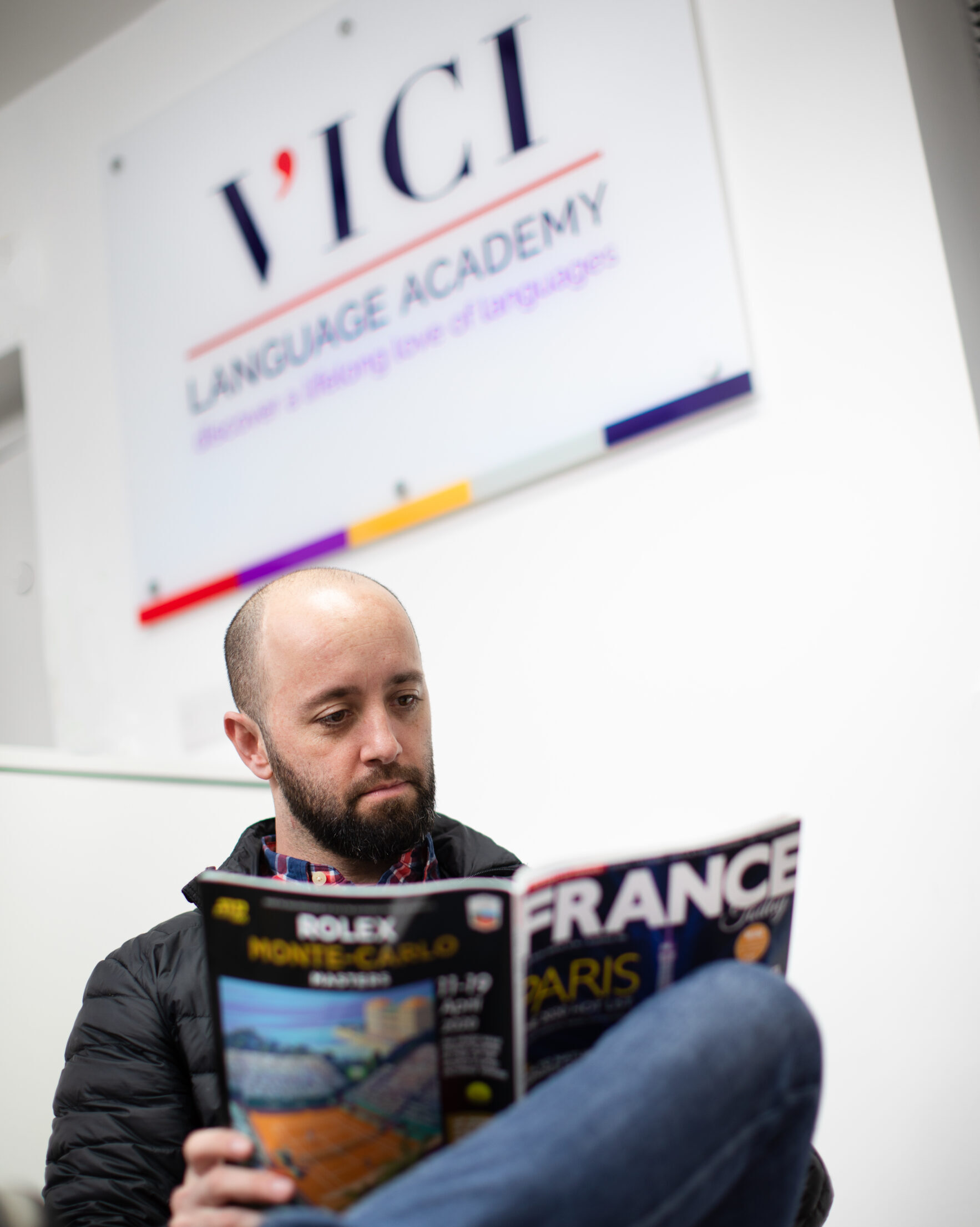
Steve enjoying a moment of French reading at our Newbury academy — living the language beyond the classroom!
Assessing Progress — the Right Way
Progress is not a feeling — it’s measurable.
At VICI, we assess progress against clear, communicative benchmarks — not vague notions of “getting better.”
You should always know what good performance looks like at your level, and what specific skills will take you to the next one.
To assess your progress the right way, break your language learning down into manageable milestones across the five CEFR communicative skills:
1. Listening: Can you follow the main ideas in everyday conversations, TV, or meetings without relying on every word?
2. Reading: Can you extract meaning from real texts — emails, articles, signs — even if the grammar isn’t perfect
3. Spoken interaction: Can you hold conversations naturally, respond quickly, and adapt your tone depending on who you’re talking to?
4. Spoken production: Can you describe, explain, and tell stories clearly, with growing fluency and confidence
5. Writing: Can you express ideas in writing that’s clear, structured, and suited to the situation (email, report, message)?
Now, take a moment to self-check:
👉 What can you already do confidently?
👉 Where do you hesitate or avoid using in your target language?
👉 Which skill, if stronger, would make your daily life or work easier?
Set one or two short-term milestones per skill — things you can do, not just knowledge to learn.
For example:
-
“Explain my job and responsibilities clearly without pausing.”
-
“Write a short professional email without using Google Translate.”
-
“Follow the main storyline of a TV show without subtitles.”
When you start thinking this way, progress stops being abstract.
It becomes visible, measurable, and motivating.
Because in the end, language progress isn’t luck — it’s the result of structure, self-awareness, and guided practice.
Turning Awareness into Progress
So, if you feel stuck, it’s not because you lack discipline, talent, or time.
It’s because no one has helped you understand how you learn.
Language learning is a personal journey. Once you understand your personality, your communicative style, your goals, and your context, everything shifts.
➡️ You stop memorising and start connecting.
➡️ You stop learning about a language and start living it.
If this resonates with you — if you want clarity on where you are, why you’re stuck, and how to move forward — I’d be delighted to help.
📧 You can reach me directly at ndanon@thevici.com
I’ll happily share our self-assessment tool and offer a personalised review of your language skills, learning profile, and next steps.
Because sometimes, as that old song reminds us,
“It’s not what you do, it’s the way that you do it.”